<aside> 🔒
Blank: encrypted payment amounts on public Ethereum.
Sender, receiver, and memo are public on-chain. The amount is an FHE ciphertext (euint64) that only the two parties can decrypt. Not a mixer. Same chain, same finality, different visibility.
Live on Ethereum Sepolia (11155111), Base Sepolia (84532), and Arbitrum Sepolia (421614). The core contract set is identical on all three; Arbitrum additionally carries the conditional-invoice escrow upgrade and its InvoiceApprovalResolver. Built on Fhenix CoFHE plus ERC-4337 account abstraction (passkey login, sponsored gas). The aggregate counts below (tests, contracts, screens, transactions) are current as of release testnet-2026-06-13. The contract-level FHE-primitive and ACL counts are from the testnet-2026-05-26 snapshot and tick up by a handful with the conditional invoice; re-grep against main for exact current values.
</aside>
Key links
Proof links
testnet-2026-06-13A payments app where the amount is the only secret. A normal ERC-20 Transfer publishes value as a log topic. A mixer breaks the sender-to-receiver link and hides the graph. Blank does the opposite of both. It keeps the social graph fully public and auditable, and encrypts only the number.
The amount lives in storage as a euint64 handle and is never written to an event. A freelancer's client can prove on-chain that they paid. An auditor sees the counterparty link. Nobody sees the figure unless they hold the decryption key. That is the wedge: the one privacy model an auditor, a regulator, and a freelancer can all accept.
One encrypted vault (FHERC20Vault) sits under 22 product surfaces: private send, invoices, conditional invoices, escrow, payroll, group bills, gifts, inheritance, creator tips, storefront, crowdfunding, claim links, stealth payments, balance proofs, and a fiat offramp. Same FHE primitives, reused across all of them.
| Metric | Value | How to check it |
|---|---|---|
| Product surfaces | 22 (21 in the landing grid, plus conditional invoices on Arbitrum) | Features.test.tsx pins the 21 grid rows; the 22nd is Arbitrum-only |
| Solidity contracts | 31 core (44 .sol incl. AA, libs, mocks) |
ls contracts/*.sol = 31; find = 44 |
| Deployed proxies per chain | 33 per chain on all three; Arbitrum adds the conditional-invoice resolver | diff the three JSONs in packages/contracts/deployments |
| Frontend tests | 5,953 pass (264 test files) | vitest run, exit 0 |
| Contract tests | 600 (verified by count) | it( test declarations in packages/contracts/test/ |
| UUPS storage gate | 25 / 25 snapshots match | hardhat check-storage-layout --check, exit 0 |
| Product screens / hooks | 49 screens / 53 hooks (excl. tests) | ls minus *.test.* |
| On-chain test transactions | 343 across three chains | one test wallet: 96 Eth + 164 Base + 83 Arbitrum Sepolia |
FHERC20Vault. Your balance becomes an encrypted euint64 handle. Shield amounts are public (like any deposit). Your running balance after that is not.PaymentSent event logs from/to/note/timestamp with no amount field.status=0x1 finality as any Ethereum tx.
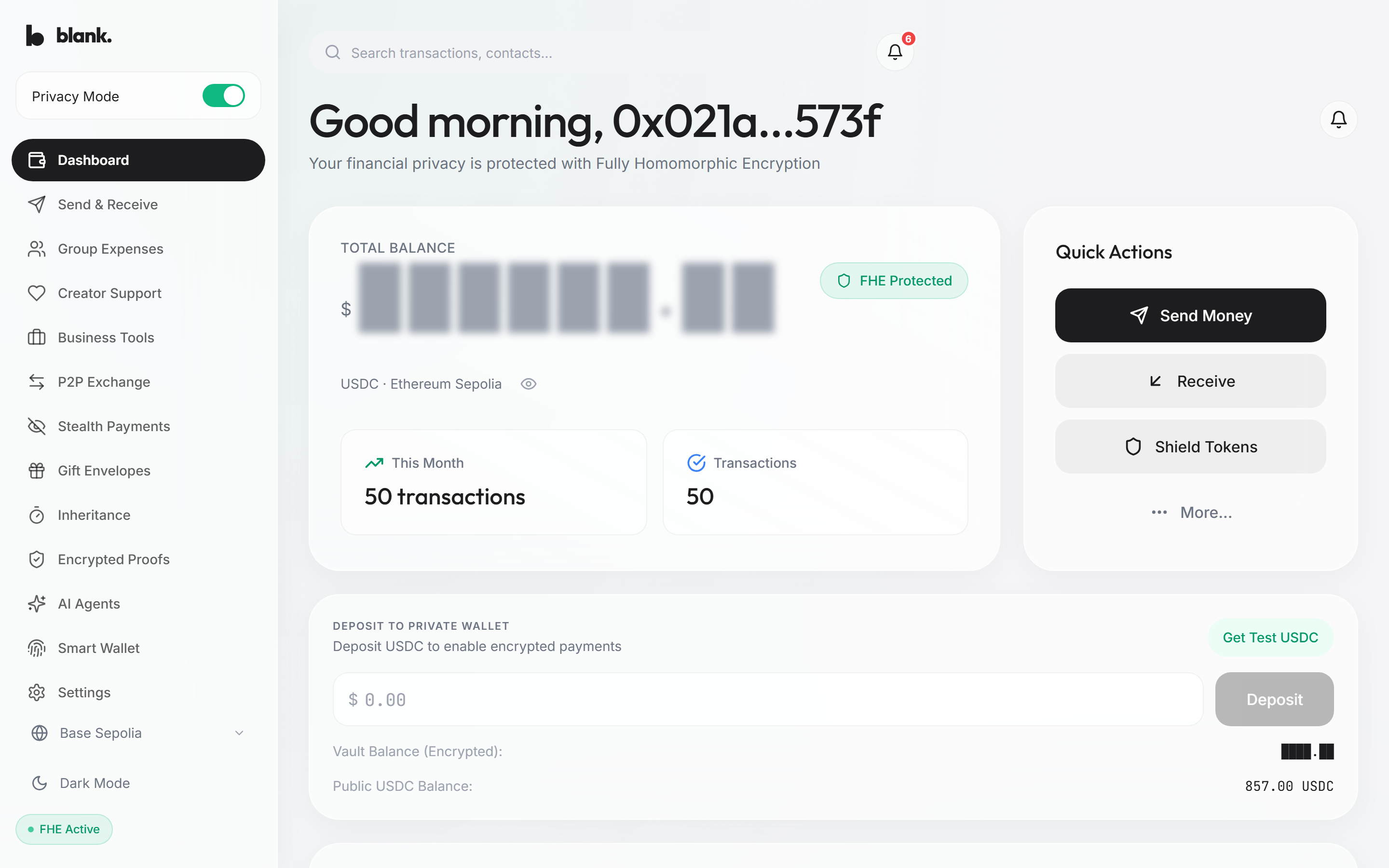
Blank dashboard, encrypted balance and activity feed
The leak vector that sinks most FHE apps is not in the code. FHE.req and FHE.decrypt have zero call sites across the 31 production contracts.
FHE.req and FHE.decrypt are comments documenting their removal (FHERC20Vault.sol:27). A require on a ciphertext leaks the secret comparison through revert and gas. It is provably not there.amount > balance silently moves an encrypted 0 instead of reverting. 22 FHE.select sites in the production contracts. Canonical pattern in FHERC20Vault: FHE.gte(balance, amount) then FHE.select(hasEnough, amount, 0).